Magento 1 officially reached end-of-life several years ago, yet thousands of online stores still run on it. Many businesses continue using Magento 1 because their stores are stable, customized, and still generating revenue. At the same time, others are planning a full Magento 1 to Magento 2 migration to improve performance, security, and scalability.
The challenge is that migration is not always the right move for every business.
Some companies benefit greatly when they migrate Magento 1 to Magento 2, while others spend heavily without seeing meaningful returns. Before investing in a migration project, business owners should understand the real costs, risks, and long-term value involved.
This guide explains when Magento migration from 1 to 2 makes sense, when it may not, and what factors businesses should evaluate before making a decision.
Magento 1 vs Magento 2: What Changed?
Magento 2 is not a simple software update. It is a complete architectural rebuild designed for modern eCommerce requirements.
Compared to Magento 1, Magento 2 offers:
- Faster page loading speeds
- Improved checkout performance
- Better mobile responsiveness
- Stronger security architecture
- Improved admin interface
- Better API and third-party integration support
Magento 2 also supports technologies like Progressive Web Apps (PWA), advanced caching, and headless commerce implementations.
These improvements matter because online shoppers now expect websites to load quickly and work seamlessly across devices. Studies consistently show that slow-loading websites reduce conversion rates and increase cart abandonment.
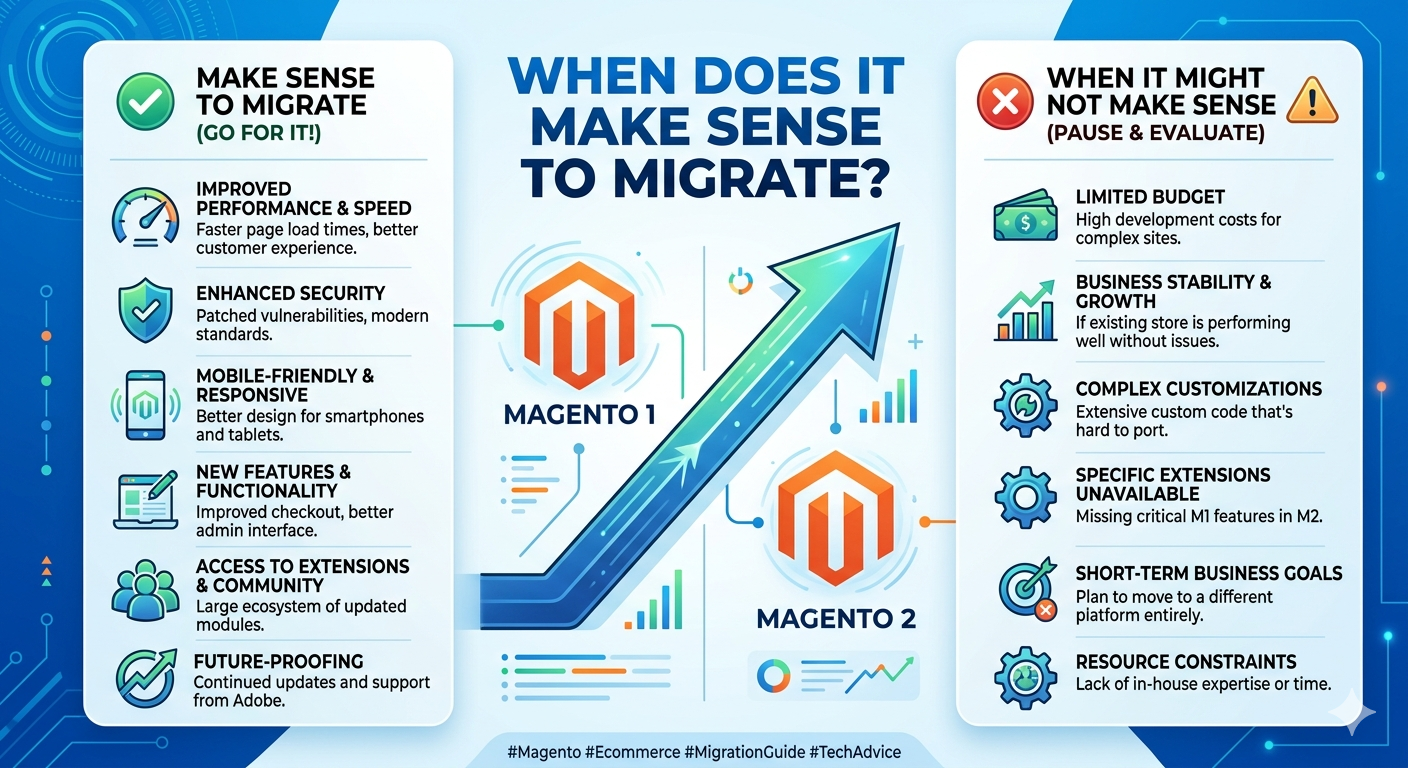
When Should You Migrate from Magento 1 to Magento 2?
Many store owners ask, “When should you migrate from Magento 1 to Magento 2?” The answer depends on business goals, technical limitations, and growth plans.
Your Website Has Security Risks
Magento 1 no longer receives official security support from Adobe. This creates long-term vulnerabilities for businesses handling customer payments and sensitive data.
If your store processes high transaction volumes, migration becomes more important. Security breaches can damage customer trust and create compliance issues.
Your Website Performance Is Affecting Sales
Magento 2 delivers noticeable speed improvements compared to Magento 1.
Businesses that experience:
- Slow product pages
- Delayed checkout
- Mobile usability issues
- Poor Core Web Vitals scores
often benefit from migration.
A faster website improves user experience and can positively impact SEO rankings and conversions.
Your Business Is Growing Rapidly
Magento 1 can become difficult to manage as businesses scale.
Migration often makes sense when:
- Product catalogs expand significantly
- Multiple storefronts are required
- International sales increase
- ERP and CRM integrations become more complex
Magento 2 offers stronger scalability and better support for enterprise-level operations.
Your Extensions Are Becoming Outdated
Many Magento 1 extensions are no longer actively maintained. Unsupported modules increase compatibility problems and security risks.
Businesses relying on outdated extensions may eventually struggle to maintain stable operations.
When Magento 2 Migration May NOT Make Sense
Although migration has advantages, it is not always the smartest business decision.
Your Magento 1 Store Is Stable and Profitable
Some Magento 1 stores continue operating successfully with minimal issues.
If your:
- Traffic is moderate
- Revenue is stable
- Customer experience is satisfactory
- Security is managed properly
then immediate migration may not be necessary.
In some cases, businesses achieve better ROI by optimizing their current infrastructure instead of rebuilding the entire store.
Your Migration Budget Is Limited
One major reason businesses delay migration is cost.
A complete Magento 1 to Magento 2 migration service can range from several thousand dollars to well over $50,000 depending on complexity.
Typical migration expenses include:
| Migration Area | Estimated Cost |
| Theme Redevelopment | $2,000–$15,000 |
| Extension Replacement | $1,000–$10,000 |
| Data Migration | $1,000–$5,000 |
| QA & Testing | $1,000–$5,000 |
| SEO Migration | $500–$3,000 |
Many businesses underestimate these costs initially.
Your Store Has Heavy Customization
Highly customized Magento 1 stores often require extensive redevelopment.
This happens because:
- Old extensions may not work in Magento 2
- Custom code requires rewriting
- Legacy integrations may break
In reality, Magento 2 migration is often closer to rebuilding a website than upgrading it.
Hidden Magento Migration Challenges Businesses Often Ignore
Migration projects frequently become larger than expected.
SEO Ranking Drops
Improper redirects, URL changes, and metadata issues can hurt search rankings during migration.
Businesses should carefully plan:
- URL structures
- 301 redirects
- Meta titles and descriptions
- XML sitemaps
- Structured data
SEO protection should be part of every magento migration services strategy.
Timeline Delays
A project expected to take six months can sometimes extend far beyond that.
Common causes include:
- Extension conflicts
- Data inconsistencies
- Third-party integration failures
- Design revisions
This is why businesses should work with an experienced Magento 2 development company.
Performance Problems After Launch
Migration alone does not guarantee better performance.
Poor hosting configurations, unoptimized themes, or bloated extensions can still slow down Magento 2 stores.
Businesses should focus on:
- Hosting quality
- CDN implementation
- Caching optimization
- Database tuning
Magento 2 ROI: Is the Investment Worth It?
Migration delivers stronger ROI for certain types of businesses.
Businesses That Usually Benefit Most
Magento 2 often works well for:
- Enterprise eCommerce brands
- Large product catalogs
- Multi-store businesses
- International sellers
- High-traffic websites
These businesses typically benefit from:
- Better scalability
- Faster operations
- Improved integrations
- Enhanced customer experience
Businesses That May Not Benefit Immediately
Smaller stores with simple requirements may not recover migration costs quickly.
If your store:
- Generates low-to-moderate revenue
- Requires limited customization
- Has stable traffic
then delaying migration may make financial sense.
Should You Upgrade, Stay on Magento 1, or Replatform?
Some businesses assume Magento 2 is their only option. That is not always true.
Depending on business goals, companies may:
- Stay temporarily on Magento 1
- Move to Magento 2
- Replatform to Shopify or another solution
For example:
- Businesses needing flexibility and customization often choose Magento 2.
- Smaller businesses seeking easier management sometimes prefer Shopify.
The right decision depends on technical requirements, growth goals, and operational resources.
Best Practices for a Smooth Magento Migration
Businesses planning to migrate Magento 1 to Magento 2 should approach the process strategically.
Start With a Full Technical Audit
Identify:
- Unused extensions
- Custom code dependencies
- Performance bottlenecks
- Security vulnerabilities
Create a Realistic Budget
Avoid underestimating:
- Design rebuild costs
- Testing requirements
- SEO migration expenses
- Ongoing maintenance
Choose the Right Magento Development Partner
An experienced Magento web development company India can reduce migration risks significantly.
Look for a provider with:
- Magento-specific expertise
- Migration case studies
- SEO migration experience
- Performance optimization skills
Working with a reliable Magento development company India helps businesses avoid costly mistakes.
Final Thoughts
A successful Magento migration from 1 to 2 depends on more than technical upgrades. Businesses should evaluate security, scalability, customer experience, operational complexity, and ROI before making a decision.
For growing eCommerce brands, Magento 2 can provide better performance, stronger integrations, and future scalability. For smaller or stable businesses, delaying migration may sometimes be the smarter financial choice.
The key is making a strategic decision based on business goals rather than industry pressure.
If you are considering a Magento 1 to Magento 2 migration service, working with an experienced migration partner can help you minimize risks, protect SEO rankings, and build a scalable eCommerce platform for long-term growth.
For expert guidance, explore professional magento migration services from Sinelogix Technologies, a trusted Magento 2 development company helping global businesses modernize their eCommerce stores.