Choosing the right ecommerce platform can directly impact your business growth, customer experience, and operational efficiency. Many online store owners start with Magento Open Source because it offers flexibility and strong customization capabilities. However, as businesses grow, they often begin comparing Magento Open Source vs Adobe Commerce to determine whether upgrading makes financial and strategic sense.
The question is simple: Is Adobe Commerce worth the upgrade? The answer depends on your business size, revenue goals, and technical requirements. In this article, we will explore the difference between Magento Open Source and Adobe Commerce, compare features and pricing, and help you decide which platform is the best fit for your business.
Understanding Magento Open Source
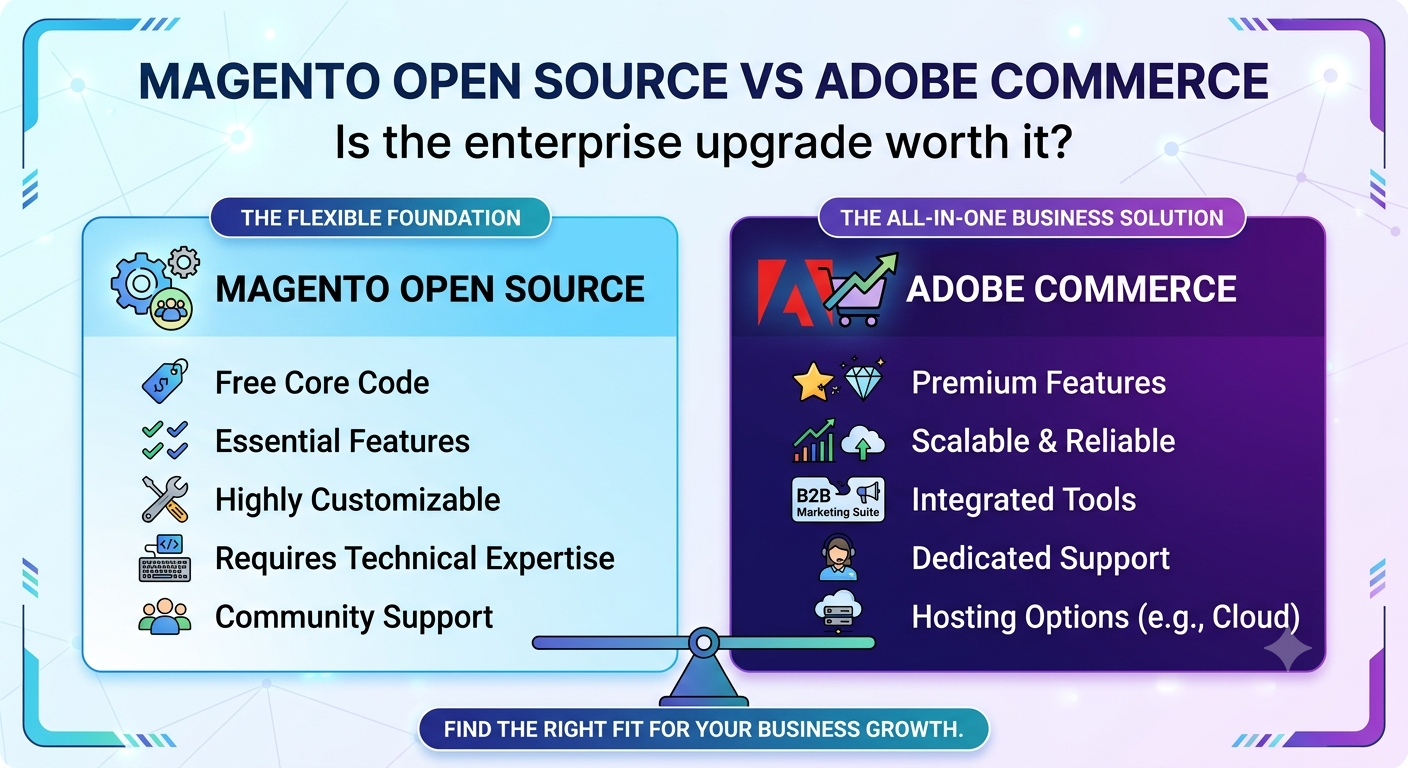
Magento Open Source is a free ecommerce platform designed for businesses that want complete control over their online store. It provides a solid foundation for creating customized shopping experiences while allowing developers to extend functionality through modules and integrations.
Many startups and small businesses choose Magento Open Source because there are no licensing fees. This makes it a cost-effective solution for companies with limited budgets.
Key features include:
- Product catalog management
- Basic SEO capabilities
- Multi-store support
- Mobile-friendly storefronts
- Third-party extensions
- Flexible customization options
While Magento Open Source offers powerful functionality, it requires businesses to manage hosting, security, updates, and performance optimization independently.
What Is Adobe Commerce?
Adobe Commerce is the enterprise version of Magento. It includes all Magento Open Source features along with advanced tools designed for larger organizations and high-growth businesses.
Adobe Commerce focuses on delivering enhanced customer experiences, automation, scalability, and business intelligence.
Additional features include:
- Advanced customer segmentation
- Personalized product recommendations
- Content staging and preview
- B2B functionality
- Visual merchandising tools
- AI-powered insights
- Advanced reporting and analytics
- Cloud infrastructure options
These features help enterprises manage large product catalogs, multiple customer groups, and complex sales processes more efficiently.
Difference Between Magento Open Source and Adobe Commerce
Understanding the difference between Magento Open Source and Adobe Commerce is essential before making an upgrade decision.
Cost Structure
The biggest difference is pricing.
Magento Open Source is free to download and use. Businesses only pay for hosting, development, extensions, and maintenance.
Adobe Commerce requires an annual license fee in addition to development and hosting costs. Pricing varies based on business revenue and requirements.
Customer Experience Features
Magento Open Source provides standard ecommerce functionality.
Adobe Commerce adds advanced personalization features that allow businesses to create unique shopping experiences based on customer behavior and preferences.
B2B Capabilities
B2B features in Magento Open Source require third-party extensions.
Adobe Commerce includes built-in B2B functionality such as company accounts, custom catalogs, quote management, and purchase approvals.
Business Intelligence
Adobe Commerce offers advanced reporting and analytics tools that help businesses make data-driven decisions.
Magento Open Source users often rely on external tools for similar insights.
Support
Magento Open Source does not include official support.
Adobe Commerce customers receive professional support from Adobe, which can be valuable during critical business operations.
Magento Open Source Limitations
Although Magento Open Source is highly flexible, it comes with certain limitations that growing businesses should consider.
Limited Native Features
Many advanced features require third-party extensions. This can increase maintenance complexity over time.
Greater Development Dependency
Store owners often need experienced developers to manage customizations, updates, and integrations.
Scalability Challenges
Magento Open Source can support large stores, but scaling often requires additional infrastructure planning and optimization.
Lack of Enterprise-Level Support
Businesses must rely on internal teams or development partners when technical issues arise.
For companies experiencing rapid growth, these limitations may create operational challenges.
Magento Open Source vs Adobe Commerce Pricing
When evaluating Magento Open Source vs Adobe Commerce pricing, businesses should look beyond licensing costs.
Magento Open Source expenses typically include:
- Hosting
- Development
- Extensions
- Security tools
- Maintenance
Adobe Commerce costs include:
- Annual licensing fees
- Development
- Hosting or cloud services
- Ongoing optimization
At first glance, Adobe Commerce appears significantly more expensive. However, some organizations find that built-in enterprise features reduce the need for multiple third-party tools, helping offset costs over time.
The real comparison should focus on total cost of ownership rather than licensing fees alone.
Adobe Commerce for Enterprise Businesses
Large organizations often require advanced capabilities that go beyond basic ecommerce functionality.
Adobe Commerce for enterprise businesses offers several advantages:
Enhanced Personalization
Businesses can deliver tailored shopping experiences based on customer behavior, purchase history, and preferences.
Improved Operational Efficiency
Built-in automation tools reduce manual workloads and improve team productivity.
Better Scalability
Adobe Commerce supports high transaction volumes and large product catalogs more effectively.
Stronger Security
Enterprise-level security features help protect customer data and support compliance requirements.
Unified Commerce Experience
Adobe Commerce integrates with other Adobe products, creating a more connected digital ecosystem.
These benefits make Adobe Commerce particularly attractive for businesses generating substantial online revenue.
Should I Upgrade From Magento Open Source to Adobe Commerce?
The answer depends on your business goals.
An upgrade may be worthwhile if:
- Your store experiences rapid growth
- You need advanced personalization
- You operate a B2B ecommerce business
- You require enterprise support
- You manage multiple brands or stores
- You need advanced reporting and analytics
However, Magento Open Source may still be the better choice if:
- You have a limited budget
- Your store is relatively small
- Your current setup meets business needs
- You have strong in-house development resources
Before making a decision, it is wise to consult experienced professionals offering Magento Website Development Services in India. The right development partner can assess your current infrastructure, growth plans, and technical requirements to recommend the most suitable platform. Businesses looking for reliable implementation and migration support often explore Magento Website Development Services in India to ensure a smooth transition and maximize platform performance.
Is Adobe Commerce Worth the Upgrade?
For enterprise organizations and rapidly growing ecommerce brands, Adobe Commerce can provide substantial value. The platform offers advanced features, stronger scalability, enhanced customer experiences, and professional support that are difficult to achieve with Magento Open Source alone.
However, not every business needs enterprise-level functionality. Smaller companies may find that Magento Open Source continues to deliver excellent results at a lower overall cost.
Ultimately, the Adobe Commerce vs Magento Open Source decision should be based on business requirements rather than platform popularity. Carefully evaluate your growth plans, operational challenges, and customer experience goals before making the investment.
Final Thoughts
The debate surrounding Magento Open Source vs Adobe Commerce has no universal answer. Both platforms offer significant advantages, but they serve different business needs.
Magento Open Source remains an excellent choice for startups and small businesses seeking flexibility and affordability. Adobe Commerce, on the other hand, delivers enterprise-grade capabilities designed to support large-scale growth.
If your business requires advanced personalization, automation, analytics, and scalability, the upgrade may be a strategic investment. If your current store performs well and your requirements remain straightforward, Magento Open Source may continue to be the right solution for years to come.