Choosing the right e-commerce platform is one of the biggest decisions for any online business. Your platform affects everything from website speed and SEO performance to customer experience and long-term operating costs.
That’s why the debate around Magento vs WooCommerce continues to grow among startups, mid-sized businesses, and enterprise brands.
At first glance, WooCommerce looks more affordable and beginner-friendly. Magento, on the other hand, is known for enterprise scalability and advanced customisation. The challenge is figuring out which platform delivers long-term value without creating technical or financial headaches later.
This guide breaks down the real differences between WooCommerce vs Magento, including pricing, scalability, SEO, maintenance, and performance, so you can make a smarter business decision.
Magento vs WooCommerce: Quick Overview
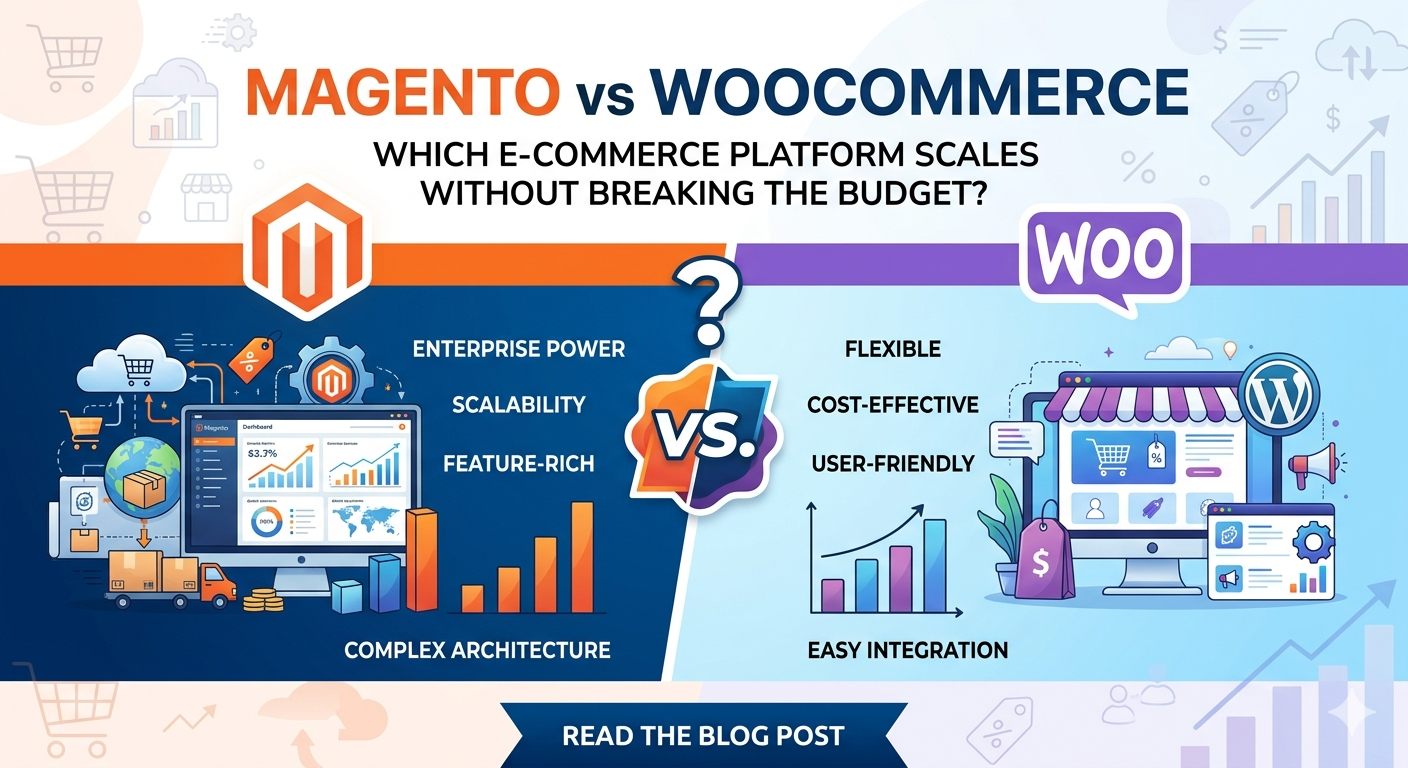
Magento and WooCommerce are both powerful e-commerce platforms, but they serve different business needs.
WooCommerce is a WordPress plugin designed for small to medium-sized online stores. It’s easy to set up, flexible, and cost-effective for businesses starting their ecommerce journey.
Magento, now known as Adobe Commerce for enterprise users, is built for businesses that expect high traffic, complex operations, and large product catalogs. Many global ecommerce brands choose Magento because of its scalability and advanced capabilities.
Here’s the simplest way to look at it:
- WooCommerce works well for simplicity and affordability.
- Magento works better for scalability and enterprise-level growth.
Understanding the Real Cost Difference
Many businesses compare only the upfront setup cost. That often leads to problems later.
WooCommerce is cheaper to launch because the core plugin is free. You can start a basic e-commerce store with affordable hosting, a premium theme, and a few plugins. This makes it attractive for startups and small businesses.
However, costs can rise quickly as your store grows. Businesses often add multiple plugins for SEO, security, speed optimisation, inventory management, and checkout customisation. Over time, plugin subscriptions, compatibility issues, and performance fixes increase maintenance costs.
Magento usually requires a higher initial investment. Development, hosting, and customization costs are significantly higher than WooCommerce. Yet Magento becomes more cost-efficient for businesses operating at scale because it handles complex ecommerce requirements more efficiently.
For example, Magento can manage:
- Multiple storefronts
- Large inventories
- International pricing
- Advanced customer segmentation
- B2B ecommerce workflows
without depending heavily on third-party plugins.
That’s one reason many growing brands invest in professional magento web development services early in their growth journey.
Which Platform Scales Better?
Scalability is where Magento clearly stands out.
WooCommerce performs well for small and medium ecommerce stores. If your website has moderate traffic and a manageable product catalog, WooCommerce can work smoothly with the right hosting setup.
The challenge appears when:
- Traffic spikes during sales campaigns
- Product catalogs become very large
- Multiple plugins overload the website
- Database queries slow down performance
At this stage, businesses often spend heavily on optimization and server upgrades just to maintain acceptable performance.
Magento was designed for scalability from the beginning. It handles large product databases, high traffic volumes, and enterprise-level operations far more effectively.
Large ecommerce businesses prefer Magento because it supports:
- Advanced caching
- Multi-store management
- Better database handling
- Flexible server infrastructure
- High-performance integrations
For businesses planning aggressive growth, Magento provides a stronger long-term foundation.
Magento vs WooCommerce for SEO
SEO plays a major role in ecommerce success. A platform that supports strong technical SEO can improve rankings, visibility, and organic sales.
WooCommerce has a major advantage because it runs on WordPress. Content marketing becomes easier with blogging tools and SEO plugins like Yoast SEO or Rank Math. Small businesses often prefer WooCommerce because they can publish optimized content without technical complexity.
Magento offers more advanced SEO flexibility. It gives developers deeper control over:
- URL structures
- Canonical tags
- Structured data
- Category architecture
- Crawl optimization
Magento also performs better for very large ecommerce stores with thousands of products and categories.
For smaller content-driven businesses, WooCommerce may feel easier. For enterprise SEO scalability, Magento usually performs better in the long run.
Ease of Use and Store Management
WooCommerce is generally easier for non-technical users.
Its WordPress dashboard feels familiar and simple. Product uploads, blog publishing, and content updates can usually be managed without developer assistance.
Magento has a steeper learning curve. Its admin panel is more advanced and often requires technical knowledge to use effectively. Businesses using Magento typically work with experienced developers or a dedicated ecommerce agency.
This is why many companies partner with a reliable magento web development Company In India to handle development, maintenance, and performance optimization.
Indian Magento development companies have become popular globally because they offer:
- Cost-effective development
- Skilled Magento experts
- Custom ecommerce solutions
- Ongoing support and maintenance
Security and Maintenance Comparison
Security becomes increasingly important as ecommerce businesses grow.
WooCommerce security depends heavily on hosting quality, plugins, and regular updates. Since many stores use numerous third-party plugins, security vulnerabilities can increase if updates are ignored.
Magento is known for stronger enterprise-level security. It offers:
- Advanced user permissions
- Dedicated security patches
- Better compliance support
- Scalable security architecture
This makes Magento a preferred option for larger ecommerce businesses handling sensitive customer data and high transaction volumes.
Maintenance requirements also differ significantly.
WooCommerce stores often need ongoing plugin updates and compatibility testing. Magento maintenance is more technical but generally more stable for large-scale ecommerce operations.
Which Platform Is Best for Your Business?
The answer depends on your business goals.
Choose WooCommerce if:
- You are launching a startup ecommerce store
- You have a smaller budget
- Content marketing is a major priority
- You want easier website management
Choose Magento if:
- You expect rapid growth
- You manage large inventories
- You need enterprise-level customization
- You plan to scale globally
Many businesses begin with WooCommerce and eventually migrate to Magento once operational complexity increases.
That migration process can become challenging if not planned correctly. SEO rankings, URLs, customer data, and product structures must all be preserved carefully during migration.
Final Verdict: WooCommerce vs Magento
The comparison between magento vs woocommerce is not about choosing a universally better platform. It’s about choosing the right platform for your current business stage and future growth plans.
WooCommerce offers affordability, flexibility, and ease of use for smaller businesses. Magento delivers superior scalability, customization, and enterprise-level performance for brands planning long-term growth.
If your goal is to build a highly scalable ecommerce business without constant technical limitations, Magento often provides stronger long-term value despite the higher initial investment.
Businesses looking for expert guidance can benefit from working with experienced ecommerce professionals who understand both platforms deeply.
At Sinelogix Technologies, businesses can access custom ecommerce development, migration support, SEO optimization, and scalable magento web development services tailored to their growth goals.